Monday, June 19, 2006

Monday Morning Coffee Reading

Krugman
I would like to offer some advice to my fellow pundits: face reality. There are some commentators who long for the bipartisan days of yore, and flock eagerly to any politician who looks "centrist." But there isn't any center in modern American politics. And the center won't return until we have a new New Deal, and rebuild our middle class.

Republican methodology to divide and conquer the middle class, both against itself and against the lower classes, is something that seems to hamstring the Dems on two levels. On one level, they are compelled to counter arguments regarding Gay marriage, etc. thereby entering into an argument they cannot win largely because the problem doesn't really exist in the frist place. On another, some of them (cough Leiberman) are beholden to the same rich constiuency that the Republicans favor. When Democrats run "centrist" campaigns (and notice that it is usually Democrats and not Republicans that make a big show of centrism)they're falling into trap of trying to unite artificially divided constiuencies.

O'Reilly Vs, Stewart (via Atrios)
Responding to a segment on the June 13 broadcast of The Daily Show during which host Jon Stewart satirized O'Reilly's recent trip to Guantanamo Bay, Cuba, O'Reilly suggested that Abu Bakar Bashir -- the extremist religious leader recently released from prison where he was serving time for his role in the 2002 Bali terrorist attacks -- could "bunk with" Stewart "when he comes to the USA." O'Reilly then characterized his own "program" as "serious" -- as opposed to Stewart's "comedy show" -- and asserted that while being "a smart guy," Stewart has taken to pandering to the "[d]opey college kids" who "are gonna watch him."

Bring it on Bee-oo--tch. Seriously, this little feud is already over. O'Reilly's got nothing. If you read the transcript of the show, it sounds like a criticism leveled at Pink Floyd when The Wall was first released. But, hey, if Bill wants to stir shit up with Jon, let him. I have a feeling Jon knew exactly what he was doing when he did that bit about O'Reilly at Gitmo.

Friday, June 16, 2006

Friday Malamute Blogging


Looking at the world sideways.

Thursday, June 15, 2006

Is the Bloom off the Rose?

David Sirota has probably one of the best pieces I've read to date on Barack Obama in this week's The Nation. The other night, I found myself in political conversation with a group of well-meaning white liberal types in which the inevitable adjective "well-spoken" was used in reference to Obama. For all that we'd like to believe we are above the racial tokenism of the right, there is a certain similarity in the way both sides treat politicians, cabinet members, etc. of color i.e. extra points for charisma, articulateness, and the like. It's annoying because it smacks of a low-grade racial panic. Oh finally, a black person I don't have to grit my teeth to like.

Obama has managed to get a lot of mileage out of his 2004 Democratic Convention speech, but if Sirota's piece is any indication, the tank is low on gas. Sirota points out that Obama shows himself to be more cautious than not.

Then there is the Iraq War. Obama says that during his 2004 election campaign he "loudly and vigorously" opposed the war. As The New Yorker noted, "many had been drawn initially by Obama's early opposition to the invasion." But "when his speech at the antiwar rally in 2002 was quietly removed from his campaign Web site," the magazine reported, "activists found that to be an ominous sign"--one that foreshadowed Obama's first months in the Senate. Indeed, through much of 2005, Obama said little about Iraq, displaying a noticeable deference to Washington's bipartisan foreign policy elite, which had pushed the war. One of Obama's first votes as a senator was to confirm Condoleezza Rice as Secretary of State despite her integral role in pushing the now-debunked propaganda about Iraq's WMD.


In November Obama's reticence on the war ended. Five days after hawkish Democratic Representative Jack Murtha famously called for a withdrawal, Obama gave a speech calling for a drawdown of troops in 2006. "Those of us in Washington have fallen behind the debate that is taking place across America on Iraq," he said. But then he retreated. On Meet the Press in January Obama regurgitated catchphrases often employed by neoconservatives to caricature those demanding a timetable for withdrawal. "It would not be responsible for us to unilaterally and precipitously draw troops down," he said. Then, as polls showed support for the war further eroding, Obama tacked again, giving a speech in May attacking the war and mocking the "idea that somehow if you say the words 'plan for victory' and 'stay the course' over and over and over and over again...that somehow people are not going to notice the 2,400 flag-draped coffins that have arrived at the Dover Air Force Base."


Sirota freely admits to being vulnerable to the Obama personality spell, referring to is "mesmerizing ability to connect with people." It is true that there is something to be said for personality, but I think that Democratic nostalgia for the cult of Clinton has been overall bad for business. Both Gore and Kerry suffered for not having that "zing" thereby exposing the chinks in the Democratic campaign machine. For Sirota to challenge Obama to be the progressive politician and not just look the part shows a degree of chutzpah.

Monday, June 12, 2006

On truths inconvenient

We saw Al Gore's An Inconvenient Truth last night. It's a must see (red rabbit may be posting on this later). What I'll say for now is that it underscores my previous post about the immediate need to define a core progressive position upon the belief that government can and must be used to solve certain problems. To be sure, the film leaves us with a host of things we can do as individuals to reduce our personal greenhouse emissions to zero, but there’s no getting around the fact that our failure to act collectively to address global warming by establishing fuel efficiency standards, limiting greenhouse gas emissions, and ratifying the Kyoto treaty stems from having allowed corporate interests rather than the public good determine national priorities.

Democrats have colluded in bringing about this state of affairs, and Paul Krugman gives us insight into how this happens in his Monday column on the way Republicans rhetorically use the phrase “Some Americans believe” (or alternately “other Americans don’t believe”) to attribute to Democrats all sorts of opinions they do not hold. This is to be expected from the Right, but part of our problem is that we get the same treatment from the left side of the aisle. Among the offenders Krugman cites is our own Senator Obama. Krugman writes:

And when Senator Barack Obama told The New Yorker that Americans "don't believe that the main lesson of the past five years is that America is an evil hegemon," he seemed to be implying that influential members of his party believe just that.

Krugman goes on to note, wryly that some might observe “that the alleged influence of the Some is no more real than the problem of flag-burning, that right-wing propagandists are attacking straw men to divert attention from the Bush administration's failures. And they wonder why people like Mr. Obama are helping these propagandists in their work.”

But, hey, this has been Obama’s m.o. from the outset. His much-ballyhooed keynote address at the Democratic National Convention included the following, “Now, don’t get me wrong. The people I meet -- in small towns and big cities, in diners and office parks -- they don’t expect government to solve all their problems,” implying, of course, that Some members of his party do expect this very thing and that the first battle to be waged is against these wild-eyed “Tax and Spenders” about whom the Republicans have warned us. But the truth is, Democrats since the Reagan era have been so intent on proving themselves not to be the stereotypes of Republican propaganda who believe that government should do everything they have systematically compromised all of the things government can and should do by granting loopholes and concessions to the corporate sector. And all that this has gotten us is a government almost unable to do anything—Grover Norquist, for one, is thrilled . . ..

Sunday, June 11, 2006

Go Tell it in Las Vegas, the Yearly Kos, or What's a Progressive Anyway?

Las Vegas sounds like it was an important political milepost. Let's hope it produces a pithy formulation of what makes someone a progressive, namely, the commitment to

(1) use public resources and power to make life better for those who live and work in this country, and (2) reduce dramatically the economic inequality between the few who control most of the nation's wealth and the many who actually create it.

All other issues, including, ending the War, protecting abortion, supporting gay marriage, etc., should orbit around these core committments.

If they don't, then we may as well be moderate Republicans, who famously declare themselves conservative on economic issues but liberal when it comes to social issues--and if you haven't noticed, moderate Republicans are an endangered species these days . . .

Friday, June 09, 2006

Friday Malamute Blogging

Freedom's just another word for trampled flowers and holes in the lawn.

Congratulations, Graduates!


Word of advice: be careful who's got your back.

Tuesday, June 06, 2006

R.I.P. Bill Bennett

I think Jon Stewart just buried you.

Friday, June 02, 2006

Friday Malamute Blogging


Yes, sometimes Kodi's awake.

Thursday, June 01, 2006

Idiocy in Black and White

If Shelby Steele were anyone other than Shelby Steele, he would bitch-slap George Will for deeming him “America’s most discerning black writer.” Given Steele's belief that only small men--“bargainers, bluffers and haranguers”--populate today's black intellectual cohort, getting hailed as the nation’s most discerning black writer must feel a bit like being lauded as the highest point of natural elevation in the state of Illinois. Surely Will could have been a bit more generous in light of Steele’s eagerness to help the cause by donning once again the hair shirt of turgid prose and psychobabble he first wore in The Content of Our Character. But to give credit where credit is due, Steele is right in saying that race and racism don’t adequately explain persistent inequality in our society. Ironically, though, this half-wit has then gone on (again and again, I might add) to explain the nation’s problems exclusively in terms of race: white guilt, black dependency, the soft bigotry of low expectations. “We blacks,” Steele writes, “always experience white guilt as an incentive, almost a command, to somehow exhibit racial woundedness and animus." We do, do we?

The real issue here, though, is neither Steele’s mental defectiveness nor Wills’ colossal arrogance but the way both of these men collude in a more sinister project. By laying the blame for current ills at the doorstep of Lyndon Johnson’s “Great Society” they seek to deflect attention from the way the policies of “neoliberalism” create and exacerbate inequality in the present. (On Neoliberalism everyone should read David Harvey’s A Brief History of Neoliberalism.) These policies confer "rights and freedoms on those 'whose income, leisure and security need no enhancing', leaving a pittance for the rest of us." The victims of these policies include and extend well beyond those Americans who happen to be black, and we need a politics that starts from an acknowledgement of that fact.

Tuesday, May 30, 2006

Remembering II

My dad never conveyed to me that he felt he deserved any special consideration for his 23 years of military service. Certainly he had sacrificed: three extended tours of duty away from us. But perhaps because he had never been under fire during the Korean, War, or in Thailand, during the Viet Nam War, he didn’t feel he had any unique claim on the nation’s gratitude, or on whatever platitudinous phrase politicians generally trot out for these sorts of holidays.

As I recall, when he spoke of the military what he talked about most readily was the social dimension of his service. He had joined the military at age 17, not long after President Harry Truman, under pressure from Civil Rights organizations, had issued executive order 9981 establishing equality of treatment and opportunity in the US Armed Forces. And although in some respects the promised equality of treatment was never fully realized for my dad (he never received the radio training that the recruiter assured him he’d get) the service was a ticket away from the hard life of a sharecropper’s son in a small segregated Arkansas town and into a world that was multiracial and—to the extent that the children of officers and enlisted men and women attended the same schools—corrosive of class differences. We—my brother, sisters and I—never felt inferior to anyone else: a sense of self we owed both to my mom and dad.

Nonetheless it is one of life’s ironies that the Cold War military from the 1950s through the 1970s provided a concrete sense of what life in a more egalitarian society might look like. I’m not sure, but this may be one of the reasons he continued to serve for as long as he did. I do know that he embraced an egalitarian vision that we should not only memorialize but also strive to realize.

Monday, May 29, 2006

Remember the Veterans


This is for my father, who served in WWII. He came home from the war 100% disabled and deeply troubled. He died when I was 10, never to know his grandchildren. I can still hear his beautiful voice singing "Would You Like to Swing on a Star?"

This is for my Uncle Quirino who was killed in WWII. His remains were shipped home more than five years after his death. This is for his brothers, my uncles: Ernesto, Marcos, Lalo, Abelicio, Quilo, and Benito. All veterans of WWII.

This is for my brothers Philip, Jr., Joseph, Valentino, and Glen. All veterans of the Vietnam war. Philip served two tours of duty in Vietnam.

Remember those who gave their lives.
Respect and value those who survived.

Saturday, May 27, 2006

A War Criminal AND a Traitor

Wow.
Henry Kissinger sent tens of thousands of young American GIs to die for a cause he knew wasn't necessary.
During secret talks with Zhou Enlai in June 1972, Kissinger explained U.S. Vietnam strategy. Following his "decent interval" approach, Kissinger argued that the White House could not accept Hanoi's proposals to eject South Vietnamese leaders from power, but would accept the political changes that could occur after the United States withdrew forces from Vietnam: "if, as a result of historical evolution it should happen over a period of time, if we can live with a Communist government in China, we ought to be able to accept it in Indochina."
Wow.

Basically all these guys gave their lives, NOT because we had to win the war, but because we couldn't afford to look as if we'd lost.

Kissinger should be hung.

(with thanks to the professor)

Friday, May 26, 2006

Friday Malamute Blogging


A Kodiak moment

Sunday, May 21, 2006

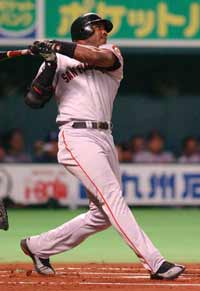
714


Barry Lamar Bonds ties the Babe's homerun record.

If Barry's taking something to help him keep his eye on the ball, then I can think of a few people who ought to be on that drug.

I'm just sayin'...

Saturday, May 20, 2006

Hee Hee

Friday, May 19, 2006

Friday Malomar Blogging


Bagel bed schmagel bed...this is more like it...

Friday, May 12, 2006

Friday Malamute Blogging Etc.


Here's Kodi in what used to be his latest most expensive bed. As with all previous beds the relationship soured when Kodi discovered the fun of the bed isn't in the sleeping but the unstuffing.

In other news:

Woot!

President Bush’s job-approval rating has fallen to its lowest mark of his presidency, according to a new Harris Interactive poll. Of 1,003 U.S. adults surveyed in a telephone poll, 29% think Mr. Bush is doing an “excellent or pretty good” job as president, down from 35% in April and significantly lower than 43% in January. Approval ratings for Congress overall also sank, and now stand at 18%.


Champagne and ponies.

Sunday, May 07, 2006

Flanagan Shenanigans

Cry me a friggin' river.

Ezra sez.
Barbara Eherenreich isn't a Democrat. Nor is Salon a Democratic organ, nor the Upper West Side the official Democratic headquarters. Flanagan isn't being attacked by the "Democratic Party," she's just pissy because the "Democratic Party" hasn't mounted a frontal assault against those who disagree with her lifestyle choices. Indeed, this is just an extension of Flanagan's normal romantic arguments to politics: she is a weak, vulnerable women in need of protection. Whether the answer is a strong man or an attentive party, the common problem is always her protested helplessness, which she insists all women share. The Democratic Party did nothing to Flanagan save not take sufficient notice of her assailants. And for that they get lambasted in the pages of Time. Flanagan also writes:

I have made a lifestyle choice that they can't stand, and I'm not cowering in the closet because of it. I'm out, and I'm proud. I am a happy member of an exceedingly "traditional" family. I'm in charge of the house and the kids, my husband is in charge of the finances and the car maintenance, and we all go to church every Sunday.

Her husband is a topflight television executive. She is a writer for The New Yorker. They have a nanny. They are exceedingly rich, and she has to make no tough economic choices between time with the kids and money for the rent. There ain't nothing "traditional" about that.


So sez I. Work-at-home-mom does not equal stay-at-home-mom. It's a fine distinction she can't seem to grasp. Her blindness to that distinction, willful or no, is also in a sense what makes her argument about "choosing" the life of a housewife problematic. Regardless of whether she's at the TIME magazine office, or sitting at home in front of the computer in her bathrobe, Flanagan is still acting as a public person. She is mistaking the domestic sphere as merely her physical space not the intellectual space she inhabits. Because her workspace allows her to pass to and fro between that intellectual public space and that domestic private space she has the luxury of choosing--or rather appearing to choose--the life of a housewife.

One the attractions of a career in writing is the hope of achieving the freedom to work at home and hopefully balance life between career and family. I freely admit that it was on my mind when I decided to go into academia. The reality I’m beginning to find (and this is as a single person ) is that sometimes that clear delineation between workspace and home is necessary both for productivity and for peace of mind. Flanagan would probably do better exploring the pitfalls of this particular problem instead of taking one kind of life choice and calling it another.

As far as claiming to be the “beaten wife of the Democratic Party,” oh please shut the hell up. In the first place--hello--bad metaphor. If it’s meant to be ironic it fails miserably, coming off as both overdramatic and morbid given the context. In the second, as far as people the Democratic Party have left behind, you honey are at the rear of the pack.